The Final Parts List
(These were the components used in 2002. The instrument has seen a few upgrades and changes since that time.)
| Primary Tone Generation Ahlborn Archive Model “201” | A number of MIDI modules with organ sounds are available on the market. The Ahlborn units were selected because they are available in a variety of different models with different pipe ranks. They also emulate all the functions of a true organ – individual selection of ranks, combination memory, expression, crescendo, etc., better than a one-stop-at-a-time sampler or synth module. The model “201” was chosen as the primary tone generator because its 20 ranks offered the selection of a relatively complete baroque organ, while the other Ahlborn units are intended more as add-on units. | 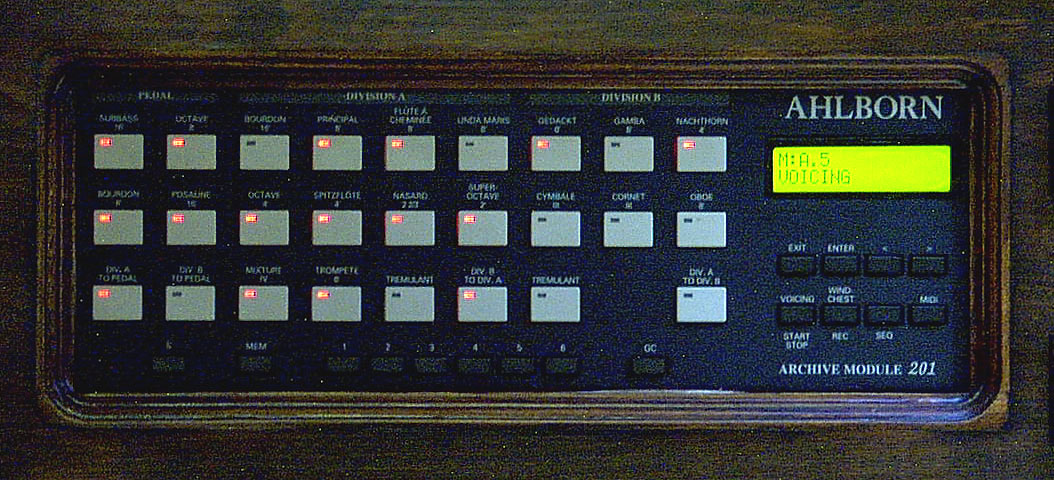 The Ahlborn 201 module provides a basic 20-rank baroque organ. |
| Additional Tone Generation Ahlborn Archive Model “Romantic” | The “Romantic” module seems at first like a bizarre choice to couple with a very baroque set of ranks from the “201”. It was originally conceived that other organists might show up who wanted to play more theater-style works, and that the Romantic could be voiced to provide tibias, strong reeds, etc. That opportunity did not arise at Burning Man, but the Romantic module can be tamed to fit in with the 201, and the addition of a 32′ pedal, plus a string celeste turned out to be quite useful. | 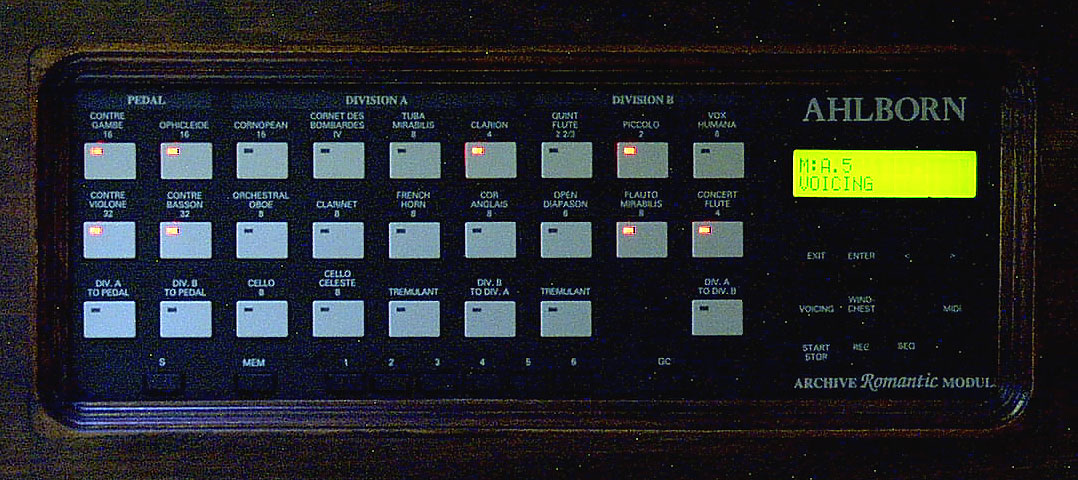 The Ahlborn Romantic module adds 20 distinctive voices, including two 32′ ranks and a string celeste. |
| Reverb Zoom RFX300 Multi-Effect Unit and later Alesis Nanoverb Multi-Effect Unit | It was unclear how the “dry” acoustical environment of the desert would sound, so a reverb/effects box was included as part of the organ design. Finding a suitable box turned out to be a major task – few are designed to run on DC power. Almost all low-cost units utilize a portion of the AC supply voltage to provide circuit timing. The Zoom could be modified to run purely on DC, so long as an isolated ground was provided on the audio connections to prevent ground hum. Now that the organ is back home, an Alesis Nanoverb (AC powered) is used – it provides a much cleaner sound with less intermodulation distortion than the Zoom. | 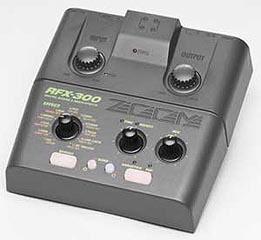 Zoom Reverb – cheap but did the job. 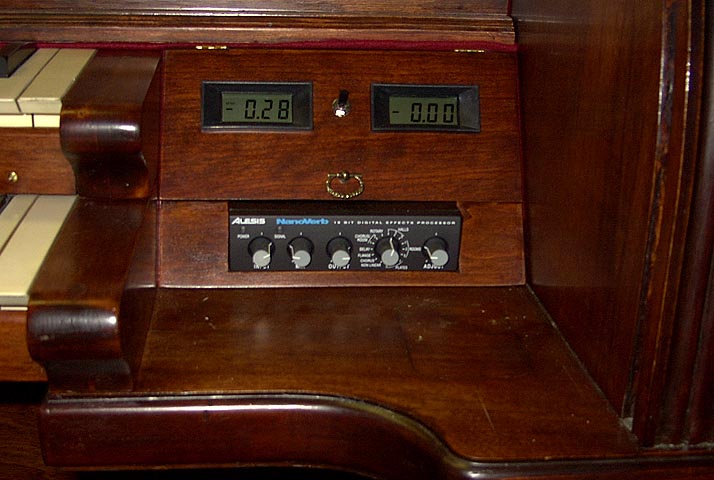 Alesis Reverb – A nice upgrade. |
| Keyboard Encoding www.midi-organ.com (No longer in business) MIDI Encoders | The raw key contacts and pedal contacts needed to be turned into MIDI messages to pass on to the sound modules. MIDI-ORGAN.com provides a variety of encoder products. (Sadly, they are no longer in business.) I selected the 122-contact (2 keyboard) encoder and 32-contact (pedal) encoder. Thumb pistons on the console are wired to control the encoder MIDI channel settings. The pedalboard was extensively rebuilt and now uses magnets and reed switches instead of open contacts, to counter the effects of dust in the desert. | 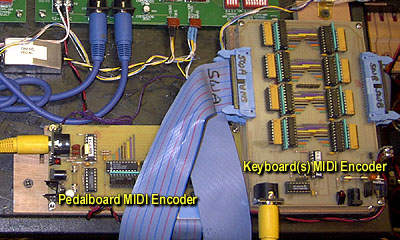 Ribbon cables run from the encoders to small junction boards affixed to the keyboards and pedalboard. |
| Expression Pedals Yamaha FC7 Volume Pedals | Three Yamaha pedals provide the potentiometer signals for Great expression, Swell expression, and Crescendo. The Crescendo pedal was modified by us to a different potentiometer value more compatible with the Syndyne boards (below). | 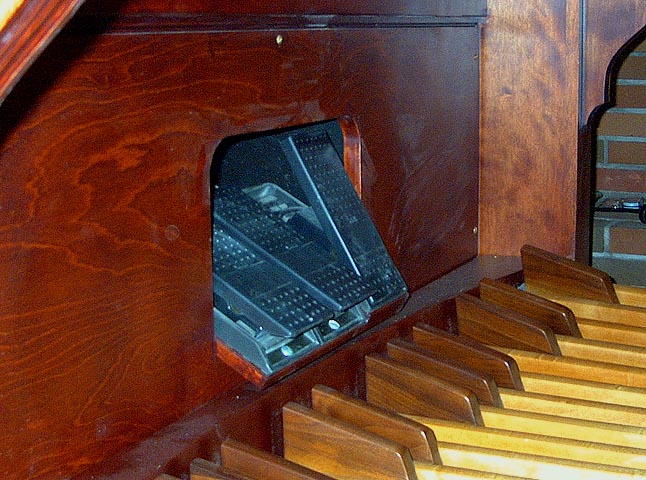 The console opening was widened to accommodate three pedals instead of two. The new shelf positions the pedals to AGO specifications. |
| Console Function Encoding Syndyne LS6401 Ahlborn Stop Tab Encoder | The Syndyne boards encode all of the console’s special functions, such as stop tabs, thumb pistons, and crescendo, into MIDI messages that are compatible with the Ahlborn units. Two Syndyne boards are in the console, one for each Ahlborn unit. | 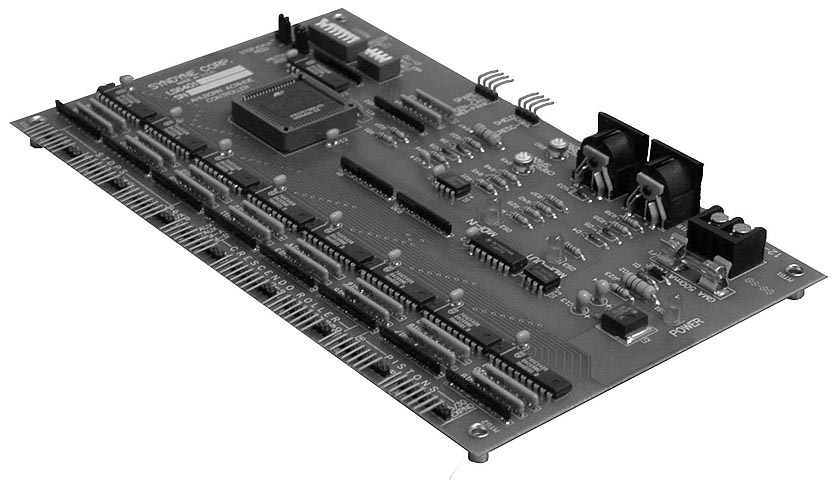 The Syndyne boards convert console functions to Ahlborn-compatible MIDI messages. |
| Stop Tabs and Thumb Pistons Syndyne Custom Tabs and Engraving | The console came with a used tab rail, and I also picked up some additional Allen stop tab switches. I ordered new stop tabs custom engraved from Syndyne in a “Notched Classical” style in ivory (stops) and black (couplers and tremulants). | 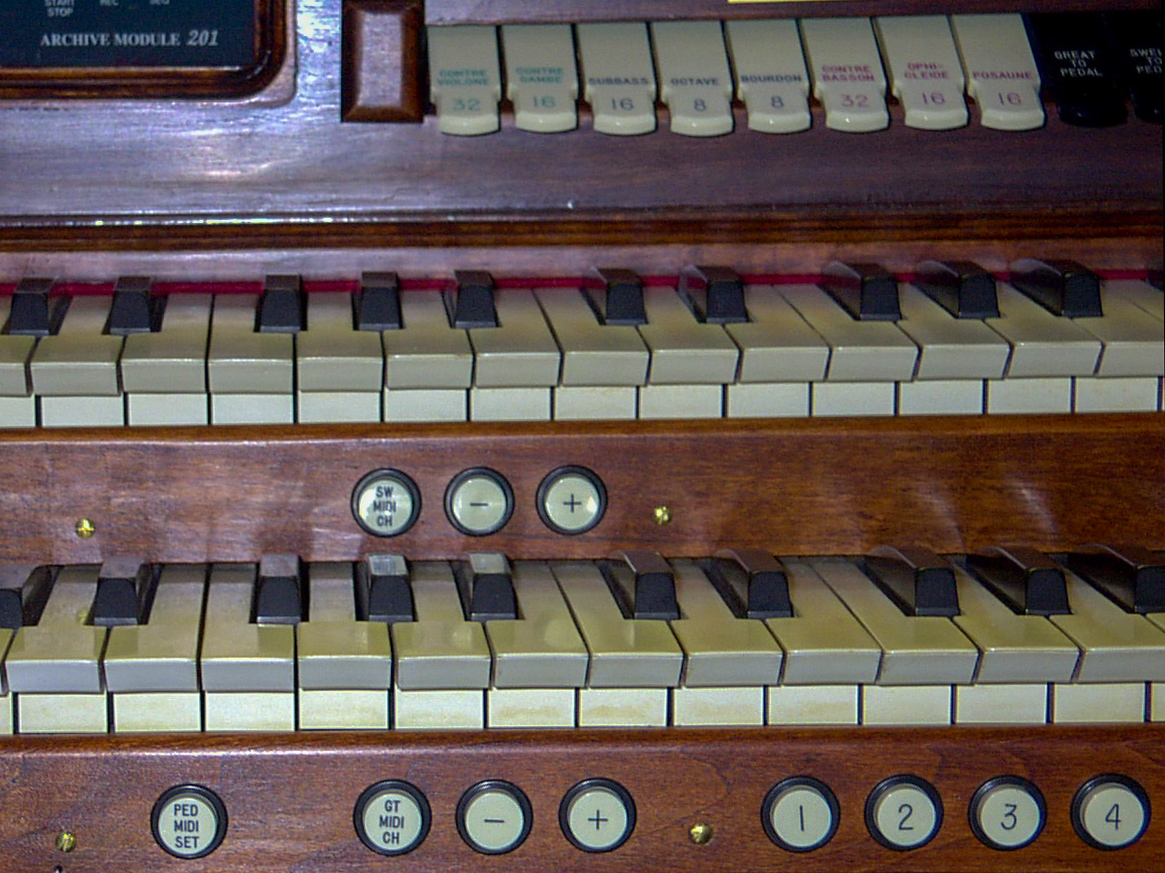 Pistons and tabs were labeled to match Ahlborn-Archive voices and functions. |
| Expression Pedal Encoding MIDI Solutions Pedal Controller | This box takes the potentiometer value measured from the expression pedal and converts it to MIDI volume control messages. (You can program the box to send different kinds of messages.) Only one box, wired to the Great expression pedal, was used initially due to budget constraints. A 2nd box was later added to read the Swell expression pedal. (This may seem backwards, but for our purposes it was more often necessary to tame the Great than it was to express the Swell.) | 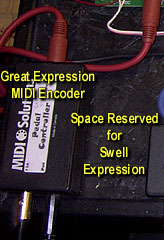 This interface is powered entirely by the MIDI bus and converts the potentiometer reading to user-programmable MIDI messages. |
| MIDI Merging MIDI Solutions Quadra Merge | There are a lot of MIDI signals running around in the console, and they all need to come together in one cable. The signals from the keyboards, pedalboard, and expression pedal are all merged by the Quadra Merge, then passed on to the Syndyne boards which add their own signals through a built-in merge function. The final result is passed to the Ahlborn 201, and then from its “thru” connector to the 2nd Ahlborn unit. | 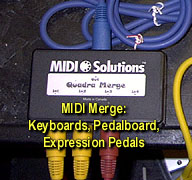 This interface is also powered entirely by the MIDI bus and merges all the keyboard, pedal, and expression “traffic” onto one cable. |
| Amplification Blaupunkt PA2150 Amplifier | Because the organ runs on 12V power, car audio amplifiers were an obvious choice. The Blaupunkt was selected because of its low power usage (especially at idle), low heat output, moderate price, and relatively low THD (total harmonic distortion) for amplifiers in its price range. Each Ahlborn unit provides a stereo output with pedal/great/swell all in a single stereo mix. The two Ahlborn units were combined into one stereo signal via a direct box (cheap but effective in this case) and fed to the reverb and amp. A car equalizer was also used in the field, but has since been removed. A permanent organ installation should have as many separate audio channels as possible, and future plans are in the works to get as many as 12 independent audio channels out of this instrument. | 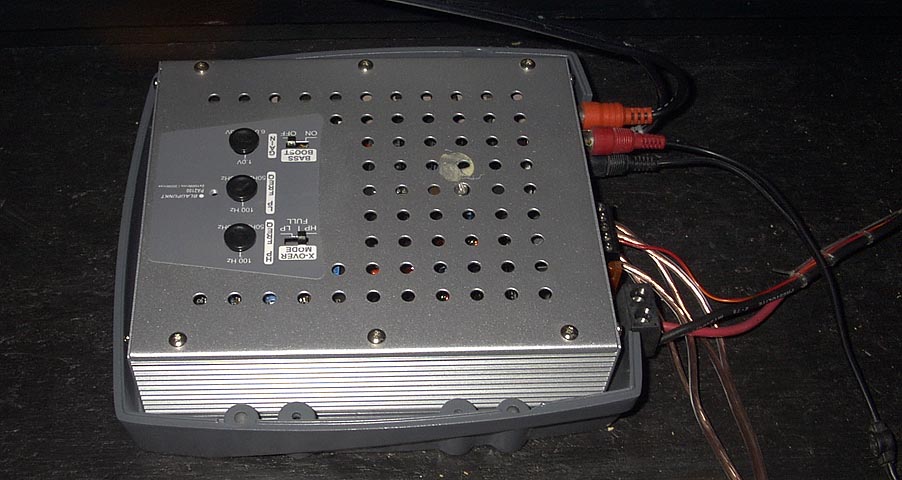 |
| Speakers Klipsch LaScala | For decades, Klipsch has designed and manufactured super-efficient horn-loaded speakers. Efficiency was just the thing we needed for an organ running off batteries. A pair of LaScala speakers, found at an insanely low price at a garge sale, were donated for this project by my father. He modified the speakers with a grille cloth to help protect them from the “Playa Dust” that gets into everything. The speakers were covered by tarps most of the time, and only uncovered for performances. | 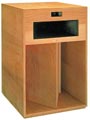 The Klipsch LaScala speaker cabinet, shown Factory-New… 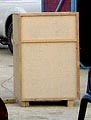 …and after the addition of a protective grille cloth. |
| Lighting LED Lighting Systems, Inc. (No longer in business) Multi-LED Strips | Every aspect of lighting for the console was custom designed. We chose to utilize the latest white LED technology, for bright output and very low power consumption. LED Lighting Systems, Inc. offers PC boards with LEDs pre-mounted in various lengths which may even be cut into sections if necessary. Although LEDs are costly compared to light bulbs, with a 120,000hr rating, the console may outlive the organist without needing to change a single bulb. |  |
Stop List:
When you combine the Ahlborn 201 and Romantic modules, you get a stop list that looks like this:
| Great | Swell | Pedal |
|---|---|---|
| Bourdon 16′ Principal 8′ Flûte à cheminée 8′ Unda Maris 8′ Cello 8′* Cello Celeste 8′* Octave 4′ Spitzflöte 4′ Nasard 2 2/3′ Superoctave 2′ Cornet des Bombardes IV* Mixture IV Cornopean 16′* Tuba Mirabilis 8′* Cor Anglais 8′* Trompete 8′ French Horn 8′* Orchestral Oboe 8′* Clarinet 8′* Clarion 4′* Swell to Great Tremulant | Open Diapason 8′* Flauto Mirabilis 8′* Gedackt 8′ Gamba 8′ Concert Flute 4′* Nachthorn 4′ Quint Flute 2 2/3′* Piccolo 2′* Cymbale III Cornet III Oboe 8′ Vox Humana 8′* Great to Swell Tremulant | Contre Violone 32′* Contre Gambe 16′* Subbass 16′ Octave 8′ Bourdon 8′ Contre Basson 32′* Ophicleide 16′* Posaune 16′ Great to Pedal Swell to Pedal |